 CALL
CALL TEXT
TEXT SHOP
SHOPYour Cart is Empty
-
FREE Shipping on Gen-2 Wagons + $100 OFF With Direct Pay | Ends 10/31/26
A cheap electric beach wagon can seem like a win until the first real beach trip. The listing looks promising, the price feels easier to justify, and the photos make it seem ready for coolers, chairs, towels, and a long walk across the sand. Then the wagon actually hits the soft sand, and suddenly the wheels start spinning, the frame is under a lot of stress and pressure, and the motor is fighting for its life and losing.
That is the problem with cheap electric beach wagons. Some, if not most, are simply not built for sand at all, while others may look beach-ready but fall short after repeated use. But people still need a reliable option that won't be a total waste of their money and will actually hold up after years of beach trips and outings. That's why in today’s blog, we’ll look at what usually fails first, what details matter most, and what you should buy instead, so keep reading to learn more!
A lot of things. Cheaper electric beach wagons usually fail because they are built around the idea of convenience, not the reality of repeated beach use. They may look sturdy online, but sand, salt air, weight, and moisture can quickly reveal weak points in the design.
Many lower-cost models are promoted for beach trips, camping, gardening, tailgates, and errands. That can make them seem versatile, but a wagon that works on a sidewalk, lawn, or packed trail is not automatically ready for soft sand.
That's especially true when the listing focuses on folding size, basic electric movement, or low pricing instead of sand performance, motor strength, frame material, wheel quality, and long-term durability.
The real cost of a cheaper electric beach wagon is not always the checkout price. If the wagon gets stuck, rusts, wears out, or needs to be replaced after a few seasons, the “deal” starts to feel different from how it did once you first bought it.
When you look past the price tag and compare the motor, wheels, battery, frame, hardware, and support, it is easier to see what makes quality electric beach wagons more expensive.

One of the biggest differences between electric wagons is how much work the motor actually does. "Electric" does not necessarily mean a wagon can move a heavy load through soft sand on its own.
Some electric wagons use an assist-style drive system, where the motor helps reduce the effort required to move the wagon. That may work well on pavement, grass, or other firm surfaces, but in deep, soft sand, the user may still need to pull or push to keep the wagon moving.
Other electric wagons are self-propelled but use smaller drive systems designed primarily for general-purpose use. For example, the Litheli W1 Pro uses a 20V drive system with a 500W motor and is rated to carry up to 132 lbs. By comparison, the e-Beach Wagon uses a 48V drive system with an 800W motor producing 53 N·m of torque and is rated to carry up to 350 lbs.
The difference became obvious during our electric wagon soft sand test at Cape May Beach, where the Litheli's wheels spun and dug into the sand, requiring the wagon to be physically pulled to keep moving.
The e-Beach Wagon is designed specifically to move heavy loads through soft beach sand without requiring the user to provide the pulling force.
Motor wattage alone does not determine how well an electric wagon will perform in sand. Torque, gearing, traction, wheel size, and tire footprint all play an important role. That's why the e-Beach Wagon combines its 48V, 800W drive system and 53 N·m of torque with large, low-pressure balloon tires designed to travel over soft sand rather than dig into it.
The result is an important difference for the person using the wagon: you control the speed and guide the wagon, while the wagon does the pulling. When you're hauling coolers, chairs, umbrellas, fishing gear, towels, or other beach supplies through deep sand, the wagon should be doing the heavy lifting for you.

Wheels are one of the first details shoppers should check before buying an electric beach wagon. A motor can only do so much if the wheels are not designed for the surface underneath them.
Regular utility wheels may roll fine on pavement, grass, packed dirt, or a driveway. Soft sand is different. Narrow, hard, or small wheels can sink below the surface and create drag. When that happens, the motor may spin the wheels without moving the wagon forward. The load gets heavier, the wheels dig deeper, and the user ends up pulling harder than expected.
Low-pressure balloon wheels are designed differently. Their wider, low-pressure design helps spread the load over more surface area, which makes it easier for the wagon to stay on top of soft sand instead of cutting into it.
A loaded wagon needs wheels that are made for soft sand because the wrong shape or material can make the tires sink before the motor has a chance to help. Still, wheels are only one part of the story, albeit the biggest one.
Not all low-pressure wheels are built the same way, though. The e-Beach Wagon uses wheels made of premium polyurethane, which hold up to the extreme conditions of repeated beach use. Some cheaper alternatives use PVC instead, which can stretch and soften in extreme heat.
It really depends on more things than just that feature alone. Some newer cheap electric beach wagons are more advanced than your basic utility wagons. A foldable model with balloon wheels may be a step above a manual cart, but that does not automatically make it a long-term beach-ready option.
A low-cost foldable electric beach wagon with balloon wheels may perform better in sand than a utility wagon with standard tires. Still, wheels do not tell the whole story.
The frame, fabric, joints, motor housing, battery, hardware, and electrical protection all matter. If those parts are not made for sand, salt air, moisture, and repeated use, the wagon may still wear faster than expected.
Foldable designs are convenient, but they often rely on more joints, moving parts, fabric panels, folding, and lighter frame materials. Those areas can loosen, stretch, tear, rust, or weaken over time. Beach environments are especially tough because sand gets into moving parts, and salt air corrosion can be hard on cheaper metal parts, folding joints, screws, and exposed hardware.
Folding designs also come with a more practical drawback: payload capacity. Because they rely on lighter frames and hinged joints to fold down, foldable wagons typically carry far less weight than fixed-frame models — which matters once you're loading up coolers, chairs, umbrellas, and fishing gear for a full day at the beach.

Now we're getting into the nitty-gritty of the topic. A reliable electric beach wagon should be judged as a complete system. Price matters, of course, but it should not be the only thing guiding your purchase.
A better option should combine sand-ready wheels, a strong frame, a powerful motor, a dependable battery, rust-resistant materials, protected components, and useful support after purchase.
Important features to compare include:
The right choice also depends on what you bring. Family beach days, surf fishing trips, camping weekends, and tailgates all create different loads.
If you are packing rods, bait, sand spikes, coolers, shade, and towels, an electric wagon for surfing or fishing gear needs more than a motor and a low price. Organization, wheel quality, accessory space, and long-term build quality all start to matter once the wagon is fully loaded.
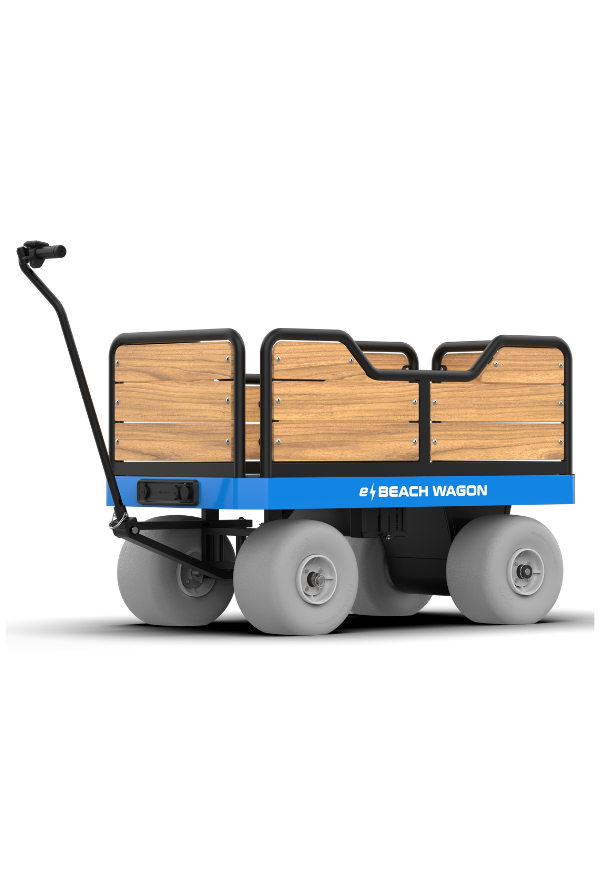
For example, the e-Beach Wagon was designed around real beach use, not just light hauling. With its Wheeleez® balloon wheels, a strong 48V/800W motor, removable 48V 30Ah LiFePO₄ battery, rust-proof aluminum frame, marine-grade stainless steel hardware, weatherproof protection, and a 4-in-1 convertible design, it is truly built for the conditions that the cheaper models you find online often underestimate.
If you are only moving a light load across firm ground, a cheaper wagon may seem fine. But if your beach trips involve soft sand, heavy gear, salt air, and repeated use, it makes more sense to choose something built for that job from the start.
That's why e-Beach Wagon is the way to go. Our motorized beach trolley is built for real beach conditions, not occasional light hauling. It is designed to handle sand, heavier loads, controlled movement, and long walks — about 25 miles per charge — from the parking area to the shoreline. With premium wheels, durable materials, and a motorized system made for the beach, it gives you a stronger long-term option than a cheaper model that may need to be dragged, repaired, or replaced.
A cheap electric beach wagon may cost less upfront, but it can become more expensive if it gets stuck, rusts, wears out, or falls short after a few seasons. e-Beach Wagon ships across the U.S., with international options available for Australia, so more beachgoers can choose a setup that is built for the sand instead of hoping a lower-cost wagon can keep up. Reach out to get your very own today!